

The morning sun had barely risen, but the village was already awake.
Voices drifted through the air—women bargaining in the market, children laughing on dusty paths, men gathering beneath the old baobab tree where decisions were made… and where girls were never invited.
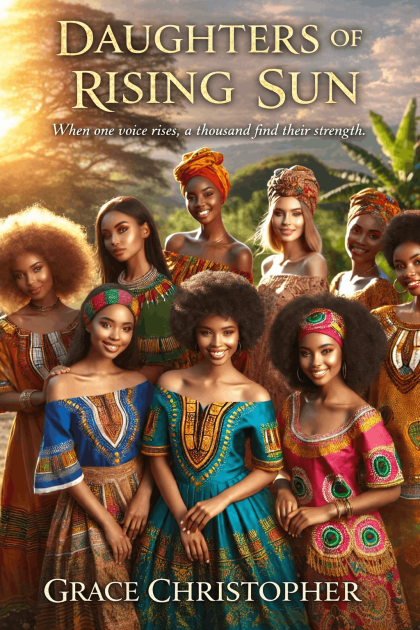
Amara sat quietly by her sewing table, her fingers moving with practiced ease as the needle danced through fabric. Bright colors—gold, deep red, and burnt orange—spilled across her lap like pieces of the sun itself.
This was her world.
Quiet. Safe. Predictable.
But today, something felt… off.
The door burst open.
“Amara!”
Lila’s voice trembled.
Amara looked up instantly, her heart tightening at the sight of her younger sister. Lila stood at the doorway, her chest rising and falling too quickly, her schoolbooks clutched tightly against her chest like they were the only thing keeping her together.
“What happened?” Amara asked, already standing.
Lila didn’t answer at first.
She just dropped the books.
And then the tears came.
“They said I can’t come back,” she whispered.
Amara froze. “What?”
Lila wiped her face, shaking her head like she didn’t want to believe her own words. “They said… they said school is not for girls anymore. That I should stay home. That it’s time to learn something ‘useful.’”
The words hung in the air like smoke.
Heavy. Suffocating.
“No,” Amara said immediately. “That doesn’t make sense. You’re one of the best students—”
“It doesn’t matter!” Lila snapped, her voice breaking. “They said it doesn’t matter how smart I am. I’m still just a girl.”
Silence filled the room.
Amara felt something shift inside her—something unfamiliar, something dangerous.
Anger.
Not loud. Not explosive.
But deep.
Steady.
Burning.
She looked at the books scattered across the floor. Pages filled with dreams. With possibilities.
With a future that was just… taken.
“Who said this?” Amara asked quietly.
“The elders,” Lila replied. “They made the announcement this morning. All girls are to stop attending school.”
Of course.
The elders.
The same men who sat under the baobab tree every day, deciding what women could and couldn’t do.
Amara’s jaw tightened.
For years, she had kept her head down. Focused on her work. Stayed out of trouble.
That was how you survived.
That was how women survived.
But looking at Lila now—broken, defeated, smaller than she had ever seemed—Amara realized something terrifying:
Silence wasn’t protecting them.
It was destroying them.
Later that day, the village buzzed with the news.
Some people agreed with the decision.
“It’s tradition,” they said.
“Girls don’t need too much education,” others added.
But not everyone was quiet.
In the corner of the market, a few women whispered among themselves.
“It’s not right,” one said.
“But what can we do?” another replied. “If we speak, they’ll shut us down.”
Amara heard every word.
And for the first time in her life… she didn’t walk away.
That night, sleep didn’t come.
Lila lay curled on the mat, her face still stained with tears. The books sat untouched in the corner, like they no longer belonged to her.
Amara sat by her sewing table.
The fabric in front of her was different tonight.
Not soft blues or gentle greens.
But bold.
Bright.
Unapologetic.
Her fingers moved slowly at first… then faster.
Thread pulled through cloth.
Needle rising and falling.
A rhythm building with every stitch.
She wasn’t just sewing.
She was thinking.
Feeling.
Deciding.
The words formed in her mind before they appeared on the fabric.
Dangerous words.
Words no one said out loud.
The next morning, the village gathered like it always did.
The market filled. The elders took their place. Life continued.
But something was about to change.
Amara stepped out of her house.
Lila looked up. “Where are you going?”
Amara didn’t answer immediately.
Instead, she adjusted the fabric draped around her body.
Bright. Impossible to ignore.
And then Lila saw it.
Her eyes widened.
“Amara…” she whispered.
Across the front of the cloth, stitched in bold, unmistakable letters, were the words:
WE DESERVE MORE
Lila’s heart pounded. “You can’t wear that.”
Amara met her gaze.
For the first time, there was no fear in her eyes.
Only quiet determination.
“Watch me.”
The moment she stepped into the market, everything slowed.
People stared.
Whispers followed her like shadows.
“Is that… what I think it is?”
“She’s going to get in trouble.”
“Has she lost her mind?”
Amara kept walking.
Each step steady. Each breath controlled.
Her heart was racing—but she didn’t stop.
She walked straight past the stalls. Past the women who avoided eye contact. Past the men who frowned in disapproval.
And then—
She stopped.
Right in front of the baobab tree.
Right where the elders sat.
The entire village seemed to hold its breath.
One of the elders leaned forward, his eyes narrowing as he read the words on her clothing.
“What is the meaning of this?” he demanded.
Amara didn’t lower her gaze.
Didn’t apologize.
Didn’t look away.
For the first time in her life…
She spoke.
“It means,” she said, her voice calm but unshakable,
“we are no longer going to stay silent.”
A gasp rippled through the crowd.
Some shocked.
Some afraid.
But somewhere in the crowd…
A young girl stepped forward.
Then another.
And another.
They didn’t say anything.
They just stood.
Watching.
Listening.
Hoping.
And just like that…
A movement was born.
Comments ()
Loading comments...
No comments yet
Be the first to share your thoughts!
Sign in to reply
Sign InYou'll be asked to sign in before posting — your comment is saved.