
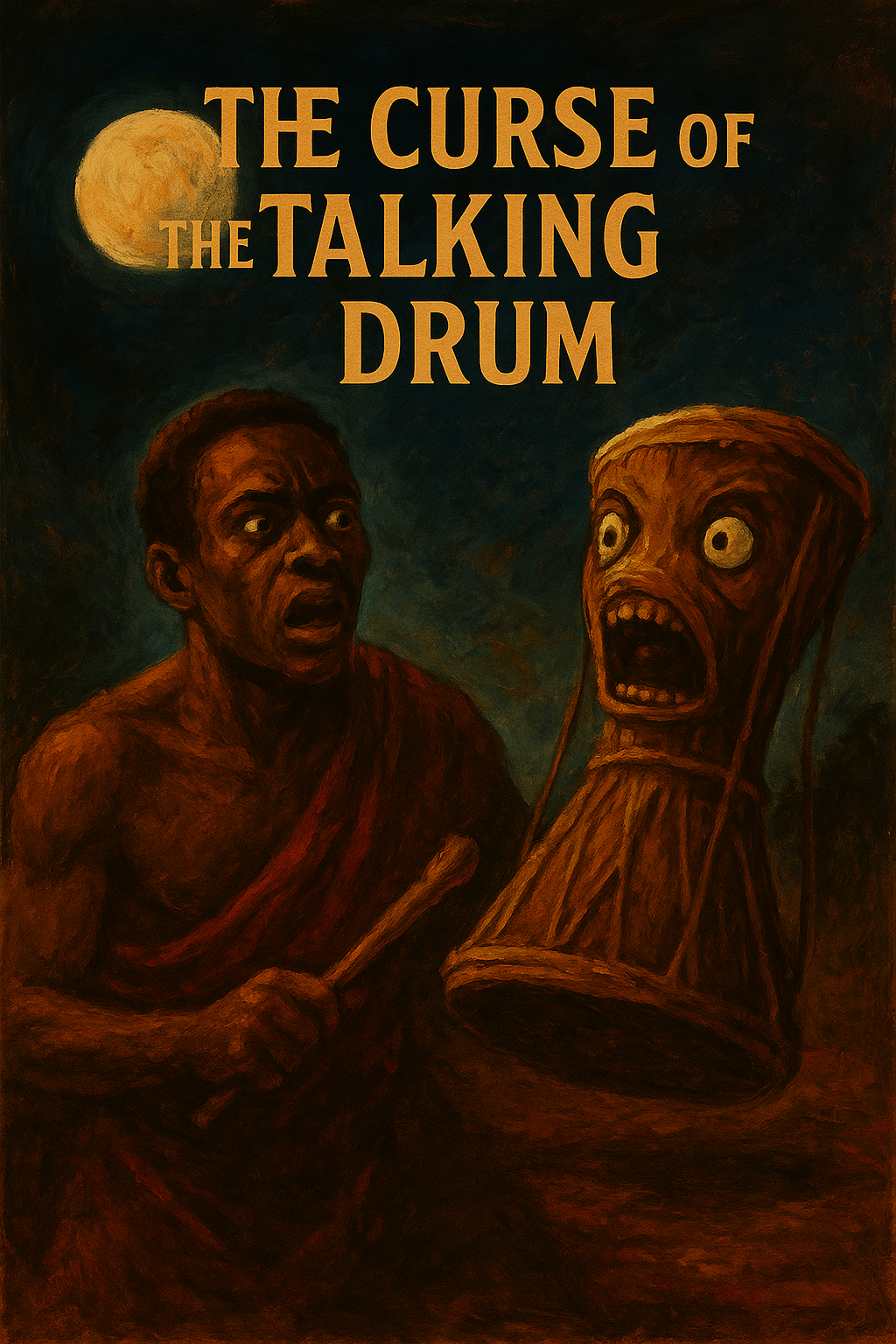
The Curse of the Talking Drum
The moon hung low over the village of Ìlúdò, its pale light glimmering on the thatched rooftops and sacred carvings of the òrìṣà. It was the night of the Ọdún Ayàn, the Festival of Drums, when the heartbeat of the ancestors echoed through the talking drums of the living.
But this year, something was different.
For the first time in generations, King Adétòkunbò had ordered that the forbidden drum, Àyànmó, be played. The drum that no hand had touched since the old diviners sealed it away. They said Àyànmó carried the voice of fate itself , that it could speak, and when it did, destinies unraveled.
Only one man was brave enough or foolish enough to play it: Adégòkè, the village’s youngest master drummer.
The Forbidden Beat
Adégòkè’s hands trembled as he approached the ancient drum. Its skin gleamed with ritual oil, cowries embedded along the rim. The elders watched in silence, their white agbádas fluttering like ghostly wings.
“Remember,” warned Bàbá Òṣunbánjó, the high priest, “no mortal should wake what sleeps within Àyànmó. The ancestors sealed it for a reason.”
But the king’s word was law.
Adégòkè bowed, placed his palms on the drum, and began to play.
The rhythm started softly, the heartbeat of the earth. Then faster, the pulse of the living. Then wild, the rhythm of chaos.
And then… the drum spoke.
Its voice was deep, like thunder rising from the underworld.
“Ẹ̀dá tí kò mọ ayé rẹ̀… Ẹ̀kún ń bò!”
(Creature who knows not his world… The wail is coming!)
The crowd screamed. The king’s guards froze. Adégòkè’s eyes rolled white as his hands locked on the drum.
The drum spoke again:
“One dawn… the village shall sink beneath its own silence. Find the one who was never buried, or all shall fade.”
Then silence. The moon dimmed, and Àyànmó cracked down the middle.
The Whispering Forest
Three nights later, Ìlúdò began to change.
Cows were found dead with their tongues missing. The river dried up overnight. And each evening, faint drumming echoed through the air, though no one played.
The villagers blamed Adégòkè. Some called him cursed, others said he had angered the gods.
Desperate, he sought Bàbá Òṣunbánjó, who told him, “The drum has spoken truth. To save us, you must find the one who was never buried.”
Guided by that prophecy, Adégòkè journeyed into Igbo Àtò, the Whispering Forest where the first drummers were born.
The forest pulsed with unseen life. The ground trembled beneath his feet. At midnight, he found a clearing filled with old graves, drummers’ graves.
But one grave was open. Inside lay another drum, identical to Àyànmó, but unbroken.
Carved into its side were the words:
“The one who was never buried shall speak again.”
Before he could touch it, a cold wind howled. The cracked Àyànmó on his back began to drum by itself.
“You have woken what must not wake. Blood must seal what rhythm broke.”
The Drummer’s Blood
Adégòkè ran back to Ìlúdò, but the village was gone. In its place was a vast, silent lake. Only the palace roof floated above the water.
He fell to his knees in despair.
Then came the voice, not from the drum, but from within him.
“Only the blood of the drummer who woke me can return what was lost.”
The priest appeared behind him, eyes wet with sorrow.
“It is your destiny, my son,” he whispered. “You are Àyànmó’s twin, born the same night it was sealed. Only your rhythm can end the curse.”
Adégòkè placed his hands on the drum one final time.
He played a slow, mournful rhythm, the rhythm of ending. His heartbeat matched the drum’s. His body grew pale, his eyes dimmed.
When the last note fell, the lake shimmered and Ìlúdò rose once more from the depths.
The villagers awoke as if from a dream. The king, the children, all alive.
But Adégòkè was gone. Only the drum remained, whole again, silent.
Epilogue
To this day, the people of Ìlúdò do not speak of Àyànmó. The drum lies buried beneath the palace, sealed in red cloth and cowrie shells.
Yet, on moonlit nights, when the wind grows still, villagers swear they hear faint drumming beneath the ground, slow, steady, human.
And if you listen closely, you may hear a whisper:
“Ẹ̀dá tí kò mọ ayé rẹ̀… Ẹ̀kún ń bò.”
(Creature who knows not his world… The wail is coming.)
Comments ()
Loading comments...
No comments yet
Be the first to share your thoughts!
Sign in to reply
Sign InSign in to join the conversation
Sign In