
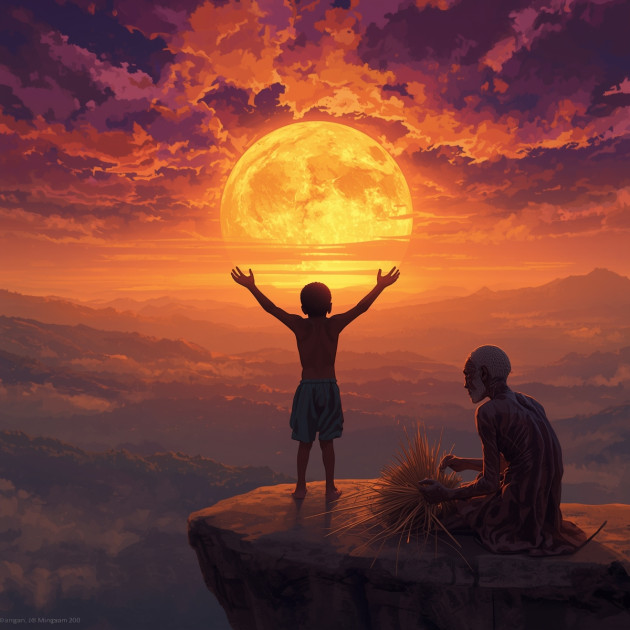
In the village of Ololobbi, nestled between the shoulder of a great red mountain and the banks of the Mama River, there lived a boy named Kofi. He was known for two things: his endless, bubbling laughter, and his deep desire to possess beautiful things. He collected smooth grey river stones, the crimson-flashed feathers of the lourie bird, and discarded cowry shells from the market traders.Yet his greatest desire was for the sunset.Each evening, as thesun completed its long journey across the sky, it would pause above the mountain's peak before sinking out of sight. In that final moment, it poured itself out ,painting the clouds in shades of orange, deep purple, and a molten gold that seemed to set the very baobab trees on fire. Kofi would stand on the riverbank, his heart aching with longing. He wanted to cup that gold in his hands. He wanted to carry it home and keep it safe inside his clay pot, so that the night would never have to be quite so dark.One evening, he decided he would try.As the sun began its final descent, Kofi scrambled up the slope of the great red mountain, his bare feet finding holds in the warm, familiar rock. He climbed higher than he had ever climbed before, until he reached a flat ledge that faced the dying sun directly. The light was so brilliant he had to squint, and a warm wind, thick with the scent of dust and wild sage, swirled around him.He stretched out his hands toward the blazing orb. He felt its heat on his skin, saw the light dancing between his fingers, and tried to scoop the fire toward his chest to capture a piece of it and call it his own."You are a persistent one, aren't you?"Kofi spun around. Sitting on a rock behind him was an old, old man. His skin was the colour and texture of baobab bark, and his eyes held the calm, deep knowledge of a river that has seen many seasons. His fingers moved steadily, weaving a basket from long, dry grasses.Kofi, too startled to be afraid, straightened his shoulders. "I am trying to catch the sunset," he said, as though it were the most natural thing in the world.The old man chuckled a sound like smooth stones rolling together in a current. "And what will you do with it, little cricket?""I will keep it," Kofi said earnestly. "I will put it in my pot, and when Grandmother's fire burns low, I will take it out and fill our hut with gold. We will never need lamps again."The old man said nothing for a moment. His fingers continued to weave, moving in and out with the patience of someone who understood that good things take time."A worthy plan," he said at last. "But tell me — when you capture it, what will happen to the sky?"Kofi frowned. He had not thought of that."And what will happen to the moon?" the old man continued, his voice as gentle as the evening air. "She is shy, that one. She only dares to show her silver face after the sun has gone. If you hold the sunset captive, she will be too afraid to rise. And if the moon does not rise, how will the lovers find their way to the riverbank? How will the children know it is time to gather for stories? How will the stars know where to place their light?"Kofi looked at his empty hands. The gold was already fading, quietly surrendering to a deep, royal purple. One by one, the first stars pricked holes in the darkening sky above him."I did not know," he whispered. "I only wanted to hold it. It is so beautiful."The old man held up the basket he had been weaving. It was perfectly formed — a tight, circular weave of golden and brown grass, round and complete as the sun itself. But it was empty."The most beautiful things," the old man said softly, placing the empty basket into Kofi's hands, "are not meant to be held. They are meant to hold us. The sunset holds the sky. The moon holds the night. And stories hold our people together across time." He looked at the boy with eyes both kind and certain. "You cannot put a story in a pot, little cricket. You can only pass it on."He rose slowly. And as he stood, he seemed to dissolve into the twilight itself — like smoke into warm air. Kofi blinked. The old man was gone, leaving nothing behind except the basket, still warm from his hands.✦ ✦ ✦Kofi climbed down the mountain in the dark, but he was not afraid. The moon — brave now that the sun had truly gone — lit his path with silver. He carried the empty basket, and yet, for the first time in as long as he could remember, he did not feel empty himself.When he reached their hut, his grandmother was crouched by the fire, stirring the embers back to life with a stick. He sat beside her. The small flames danced between them.He told her everything.He told her about the climb, the blazing light between his fingers, the old man with bark-brown skin and river-deep eyes, the empty basket and the words that had settled into him like seeds into good soil. His grandmother listened without interrupting — the way the old always listen when they sense that something true is being said.When he finished, she was quiet for a moment. Then she smiled, and the firelight caught the deep lines of her face."He was right, Kofi," she said. "And you have brought home something more valuable than any gold. You have brought a story."That night, by the light of their small fire, Kofi gave his story to his grandmother. And she, in turn, placed it safely in the one vessel that cannot crack or be stolen — in her heart, ready to be passed on again.✦ ✦ ✦✦ The Moral ✦Beauty is not diminished by being shared — it is only multiplied. The things we love most in this world are not ours to possess; they are ours to witness, to carry in our hearts, and to pass on. When we try to own what is meant to move freely, we rob not only others but ourselves. True wealth is not what we hold in our hands. It is what we hold in our memory, and what we are willing to give away.✦ ✦ ✦✦ A Note on African Culture ✦This story draws from the living heart of African oral tradition — one of the oldest and most powerful forms of human culture on earth.The Griot and the Elder: Across West, Central, and East Africa, every community holds its elders in the highest reverence. Elders are not merely old — they are living libraries. In many traditions, the griot (or jeli) is a sacred storyteller, historian, and keeper of community memory, whose duty is to ensure that the stories, genealogies, and wisdom of the people are never lost. The mysterious old man in this story embodies this figure: he appears not to lecture, but to guide through questions — just as the wisest teachers always do.Ubuntu — I Am Because We Are: The philosophy of Ubuntu, rooted across southern and central Africa, teaches that a person exists fully only in relationship to others. Kofi's desire to possess the sunset alone is, at its core, a departure from Ubuntu. The old man's correction — that beauty "holds us" rather than belonging to us — is Ubuntu in its purest form. What belongs to the community, to the sky, to nature, cannot be reduced to personal property.The Baobab Tree: Referenced throughout the story, the baobab is Africa's most sacred tree — known as the "Tree of Life." Found across sub-Saharan Africa, it can live for thousands of years and provides food, water, medicine, and shelter. To say the baobab trees were "set on fire" by the sunset's gold is to say that even the most ancient and enduring things pause to receive beauty.Storytelling by the Fire: The image of grandmother and grandchild sitting by the fire at night is not merely poetic — it is the central classroom of African village life. Before books, before schools, the fireplace was where knowledge moved from the old to the young. A child who received a story was trusted with something sacred
. A grandmother who passed one on was fulfilling her deepest duty to her people. In this way, stories are immortal they outlive every clay pot, every cowry shell, every baobab tree.The Woven Basket: Basket weaving is a tradition practiced for thousands of years across the African continent, from the intricately patterned baskets of Ghana and Botswana to the coiled sweetgrass work of the Gullah people. A basket is a container but an empty basket is a promise.
The old man's gift to Kofi is not a thing to fill; it is an invitation to understand that the most important vessels are the ones we carry inside us
."A story is not a stone you carry. It is a river you pass on." African Proverb
Comments ()
Loading comments...
No comments yet
Be the first to share your thoughts!
Sign in to reply
Sign InYou'll be asked to sign in before posting — your comment is saved.