
CHAPTER ONE
The night Isoken was born, the moon hid behind clouds. The women gathered in the small room, their wrappers tied high and their bodies glistening with sweat. A woman's powerful cries of labor cut through the quiet of the village.
Esohe gripped the raffia mat until her knuckles turned white as sweat ran down her temples soaking the scarf tied around her. The midwife pressed a hand against her swollen belly, whispering soothing words of encouragement.
“Push, my daughter… push. The gods have finally heard you at last.”
Outside, her husband paced beneath the pawpaw tree with his chest bare and his eyes fixed on the dark horizon. Fifteen years. Fifteen years of empty rooms and mocking laughter. Tonight, he told himself, it would all end. The gods would finally reward his patience with a son. That was what the chief priest assured him. A son to carry his name.
He had already chosen the name. Efosa. “The one who brings wealth.”
But when the baby came, the room fell silent.
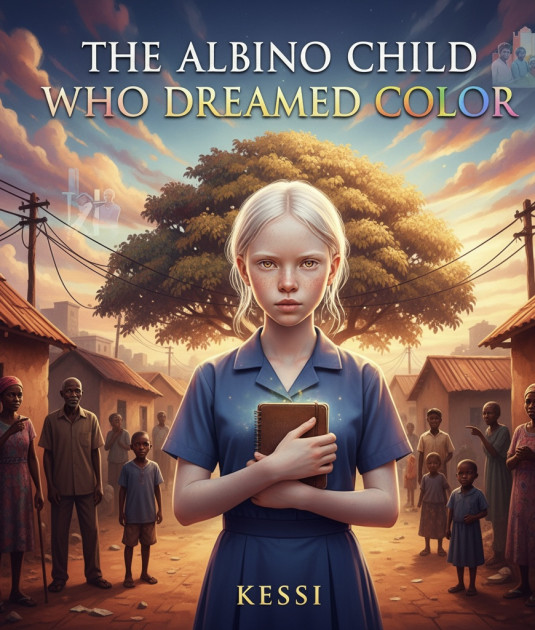
The midwife froze, her hands trembling as she lifted the child into the light of the kerosene lamp. Gasps rippled through the women present. The newborn’s skin was pale… it wasn't the warm brown of her mother, nor the deep black of her father, but it was something cold and moonlike. Her lashes were white and closed shut
“Osanobua…” one of the women whispered, circling her head.
Another muttered, “It is not normal. This child… she has no color.” she said snapping her fingers offensively
Esohe struggled to sit up, her chest heaving. “Let me see her,” she pleaded.
The midwife hesitated but she placed the child in her arms.
For a moment, the mother forgot her pain, the whispers, the fear, and the stares. The baby’s tiny fingers curled around hers which felt warm, real, and fragile.
Tears slid down her face. “My Isoken,” she whispered. “I'm satisfied with what the gods gives.”
Her husband heard the commotion and rushed into the hut, expecting to see his son swaddled in cloth. Instead, he saw her…. the pale child cradled in his wife’s arms. He stopped as the joy drained from his face and his mouth parting in shock.
“What is this?”
The midwife looked away. “She is your child,” she said softly. “A girl.”
The room became silent.
The man’s eyes darkened. “A girl?” he repeated. “After fifteen years? After all my prayers and all my sacrifices?” His gaze dropped to the child. “And you say this one is mine?”
Esohe clutched the baby closer, her voice breaking. “She is ours. She is what the gods gave.”
He turned away, his jaw tight with shame and anger burning together. The villagers would talk, of course. They always did but this time that Esohe had birthed a spirit child and a pale witch.
As dawn crept over the clay rooftops, the child with no shadow opened her golden eyes for the first time and blinked at the world that would never understand her.
CHAPTER TWO
The world around the village began to change, new power lines stretched across red rooftops, motorcycles coughing dust through narrow paths and radios crackling with foreign voices but the old beliefs were still held tight. The people had moved forward, but their minds had not.
By the time Isoken could walk, mothers instinctively pulled their children indoors when she wandered too close. They said her skin carried bad luck and that the sun itself refused to touch her. Esohe tried to protect her, but gossip is faster than love.
Everywhere they went eyes followed them like shadows. Women whispered that Esohe had lain with a spirit in the forest while some even swore they saw strange lights above her hut the night the baby came.
Esohe stopped attending gatherings or women's meetings. She carried her daughter on her back and fetched water at dawn before the world awoke. At home, she taught her the songs of brave women that her own mother had sung.
“Never bow your head,” Esohe would whisper, carefully braiding her daughter's fragile white hair. “Even when the world spits your name. You are not a mistake, Isoken. You are the gods’ reminder that light comes in different shades.”
When Isoken turned five, her father stopped speaking to her entirely. He spent his days at the palm wine joint, laughing too loudly and pretending not to hear when people called his daughter different names.
One afternoon, when the sun shone over the roofs and the air smelled of ripe mangoes, Isoken followed the sound of laughter behind the house. The other children were playing ten-ten, their bare feet beating the dusty ground in rhythm.
She stepped closer, clutching the rag doll her mother had sewn for her.
“Can I play?” she asked softly.
The laughter and noise stopped. One of the girls wrinkled her nose. “You can’t play with us. My mama said your touch burns.”
“It doesn’t,” Isoken whispered, holding out her small hand innocently.
The girl flinched back. “See her eyes! They be like cat eyes!”
The boys began to chant, “Oyibo! Witch! Half-child!” as they threw stones at her feet.
She ran, tears blurring her vision until she was finally trapped within the secure embrace of her mother’s arms.
When she was old enough for school, her name already carried a story all around the community.
“Don’t sit beside her,” the mothers would warn their children. “The spirit child steals the colors of humans.”
On her first day, she wore a uniform too big for her, the blue fabric swallowing her small frame. The sun was already high when she entered the classroom as she clutched her oversized school bag. For a second, everyone went quiet as they stared at her.
“Are you a ghost?” a boy asked, his voice cutting through the silence.
The teacher frowned. “Quiet!” she barked but even her eyes lingered on Isoken longer than they should have.
That was how the days folded into years, long, heavy and filled with questions she couldn’t answer. Her skin burned easily under the sun, so she learned to walk under shade. Her hair refused to darken like the others’, so she tied scarves to hide it. She never complained, but at night, when her mother rubbed coconut oil into her arms, she would whisper, “Mama, why am I not like them?”
Esohe would only smile. “Because you were made to be seen.”
But not everyone wanted to see her. Still, she kept going back to school because she had started to dream of something more.
One afternoon, when the teacher asked the class what they wanted to be when they grew up, the children shouted: “Nurse!” “Soldier!” “Lawyer!” “Doctor!”
Isoken raised her hand and said, “I want to create a world where everyone can belong.”
The class burst into laughter but the teacher just looked at her for once, without fear and said quietly, “Maybe one day, you will.”
That night, as the generators hummed outside and the crickets sang in the dark, Isoken wrote in her notebook:
If the world has no place for me, I will make one myself.
CHAPTER THREE
By the time Isoken turned sixteen, the town had changed but only on the surface.
There were new taller buildings, more cars and motorcycles, and a mobile mast that blinked red at night but beneath it all, the same whispers about Isoken still crawled like smoke.
She walked to school each morning in her neatly pressed uniform, her head high though she felt every stare on her skin. Her mother said confidence was armor but some days, armor felt too heavy to wear.
“Isoken!” someone shouted as she passed by the market.
It was Mama Titi, waving a broom in the air. “Tell your mother to stop using your hair for juju o! My tomatoes spoiled after you came near my stall last week.”
Then laughter followed but she didn’t answer. She never did anymore.
Her school was a square of fading paint and cracked windows, surrounded by a fence of rusted wire. In her class, the air smelled of chalk and sweat. The teacher, Mr. Aigbe, was writing the day’s lesson “TRIGONOMETRY” in large and uneven letters.
“Now, who can solve this problem?” he asked.
A few hands went up. Then slowly, Isoken’s hand followed.
The class fell silent and some students giggled.
He hesitated just long enough for everyone to notice. Then, “Yes… Isoken.”
She stood, chalk in hand, her heart beating hard. The numbers came easily to her, flowing like water. When she finished, she turned, expecting the small smile she usually earned from her mother at home.
Instead, a voice muttered from the back, “She must have used her evil powers to know it.”
Laughter rippled in the air asIsoken wentback to her seat biting atear back as Mr. Aigbe continued the lesson.
That afternoon, a rumor spread across the classrooms: people from the state ministry were coming to pick students for the annual scholarships, the best of the best.
It was the kind of opportunity that could take a child from dust to destiny.
Isoken didn't just see free education, she also saw a bridge. This scholarship meant leaving the suffocating walls of the community and gaining access to a college education in the city, and, most importantly, acquiring the resources and influence she needed to make her vision real.
Her dream of a sanctuary for the blind, the deaf, and the rejected was impossible as long as she was just the "spirit child" in her father's compound. The scholarship was her only avenue to power, the key that would unlock the money and the permission to return home and finally build a world where she and others like her could thrive.
"Your name go dey there, you are always the top at your class so there is no doubt," her mother had whispered excitedly to her a few nights before.
Isoken only smiled. She wanted to believe that, but experience had taught her that belief was a fragile thing.
The next morning, a black SUV stopped in front of the school. Two officials stepped out, their shoes shining and their smiles polite. They spoke with the principal in hushed tones before handing him a list.
Students gathered under the mango tree, eyes wide with hope.
“Quiet!” the principal barked. His glasses sat crooked on his nose as he unfolded the paper. “These are the students chosen to sit for the state examination for scholarship consideration.”
He began to read.
“Emmanuel Eromosele. Faith Omoregie. Blessing Igbinedion…”
Each name drew cheers but when he reached the end, her name was not there.
Isoken’s throat tightened. She waited but the paper was folded.
Her throat tightened.
“Sir,” Isoken said quietly, stepping forward. “Excuse me, but…”
The principal cut her off. “Go back to where you were standing, Miss Osato.”
“But sir, I had the highest grades last term,” she insisted with her voice trembling.
He sighed. “Hmm… you weren't just good enough.”
The officials glanced at the principal. Isoken turned to them. “Please, sir, I just want the chance to write the exam.”
One official adjusted his tie and asked. “Why isn’t her name on the list?”
The principal cleared his throat. “There are… community concerns about her background.”
The words hung heavy but everyone knew what that meant. Isoken felt the stares pressing into her skin, that same old fear disguised as tradition. “Am I not from this community too?” she whispered.
No one answered.
That evening, she walked home slowly, the paper from her exercise book clutched in her hand and her vision blurred under her tears.
Her father sat outside the house, fixing his radio. When he saw her, his face hardened.
“What are you crying for?” he asked.
She didn’t reply.
“Didn't I just ask you a question?” he yelled.
She startled and answered trembling, “I didn't get the scholarship.”
He scoffed and hissed, “Even if they gave you scholarship, who will give the approval of sending a spirit child to school? You’ll only bring disgrace.”
The words hit harder than any slap.
Her mother ran out of the kitchen wiping her hands. “Enough!” she shouted. “How can you talk to your daughter like that!”
He stood up, rage tightening his jaw. “How dare you shout at me because of this…” He pointed at Isoken with disgust. “This mistake of a child…”
“Don’t you dare…” her mother challenged, but a slap silenced her.
Isoken closed her eyes and ran, escaping the fight that had been a routine for years, a fight born entirely of her existence.
That night, Isoken sat outside, her books open under the dim glow of a kerosene lantern. The power was out again, the air thick with the sound of crickets and distant generators.
Her mother came to sit beside her, wrapping a shawl around her shoulders.
“Maybe God has another plan,” she said softly.
Isoken nodded, though her voice shook when she spoke. “The scholarship was more than just a school. It was my only hope to get the power I need to build my dreams.” she sighed. “I need to leave to achieve it, Mama.”
Her mother smiled sadly. “They can’t take your mind, Isoken, or stop you from achieving your dreams, and they definitely can’t stop your light.”
But as she looked down at her pale hands, glowing faintly under the lantern, Isoken wondered what if her light is the very thing they fear the most?
CHAPTER FOUR
The next morning, the air around the school buzzed with excitement. The black SUV from the state ministry was still parked under the mango tree, its silver emblem glinting in the sun. The officials had stayed back to observe classes and “assess character,” as the principal said proudly though everyone knew it was really to take pictures and for the show.
At break time, Isoken kept to the shaded side of the school compound, the cool shadow of the wall protecting her burning skin. She watched the field, feeling the sting of the previous day's scholarship denial. A thin ribbon of red had already begun to gather along her forearms where the morning heat had reached the thin fabric of her uniform.
Then, a commotion broke out near the school gate. Two older boys were laughing loudly, kicking away a crutch that belonged to Ariyo, a quiet boy from JSS3 with one weak leg from polio. Ariyo had fallen to the dusty ground and was struggling to crawl after his aid.
Some students stood by watching while others joined in chanting cruel songs.
“Hop-hopper! One leg runner!”
Isoken froze where she stood. Her instinct was to turn away and pretend not to see, like she always did when people mocked her but something shifted inside her. Maybe it was the look on Ariyo’s face, a mix of shame and helplessness that looked too much like her own reflection. She walked forward before she could think.
“Stop it!” she shouted.
The laughter stuttered to a stop.
The taller boy turned sneering. “Ah, see who dey talk! The ghost herself!”
He kicked the crutch again. “You and him can start your own school of outcasts!”
“Pick it up,” she said, her voice shaking.
“What did you say?”
“I said pick it up,” she repeated, firmer this time. “Before I make you.”
A murmur went through the crowd. Everyone knew Isoken was quiet and always walking alone. The commotion had drawn attention: the two officials from the state ministry, dark suits stark against the red earth, were walking quickly toward them.
“Is this how you treat your classmates?” one of them asked sharply. His voice silenced everyone.
She blinked quickly, the whites of her eyes burning; she’d learned to blink a certain way so her nystagmus that made the world wobble wouldn’t give her away.
The principal hurried forward, sweating. “Sir! Please, they are only… playing….”
“Only what?” the man interrupted. “Mocking a disabled child? In a government school?”
He turned to the boy still holding the crutch. “What’s your name?”
The boy stammered. “Eh… Emmanuel Eromosele, sir.”
The man’s brow lifted. “The same Emmanuel on our scholarship list?”
The principal’s eyes widened. “Sir, maybe…”
“Remove his name,” the official said flatly. “We don’t reward cruelty.”
There was sudden Gasps in air from the gathered students.
He looked around. “Who is this girl who spoke up?”
Isoken froze as Her heart pounded. She wanted to disappear but all eyes were already on her.
The teacher, Mr. Aigbe, stepped forward. “That’s Isoken Osato, sir.”
The man studied her pale skin, her trembling hands. “Yesterday you came to speak for yourself. Today, you speak for someone else. Why?”
The entire schoolyard was silent.
Isoken swallowed, feeling her voice catch in her throat but when she spoke, it came steady and clear.
“Because it’s wrong,” she said. “Because people like him… people like me… we are not curses. We are just people who look different and I don’t want to live in a world where difference means shame.”
She looked down, then up again, gathering courage she didn’t know she had.
“I have a dream,” she continued, “that one day there’ll be a sanctuary for all of us… the blind, the deaf, the lame, and even the scarred… for everyone people don’t want to see. A world where we can learn, work, laugh… and just be normal.”
The official’s expression softened. Around her, even the mocking students had gone still.
Then, quietly, the man said, “Add her name to the list.”
The principal stammered. “Sir? But…”
“No buts,” he said. “This is the kind of courage we want representing our state.”
He turned to Isoken. “Study hard, young lady. The world needs people who still believe it can be kind.”
That evening, as she walked home, the setting sun painted her pale skin in gold. For once, she didn’t hide from the light.
Maybe her mother was right, maybe her difference wasn’t a curse at all.
Maybe it was a kind of calling.
She looked up at the sky and whispered to herself, “One day, I’ll build that place.”
And though the road ahead would be long and fraught with new battles, that day, for the first time, Isoken began to dream in color.
Comments ()
Loading comments...
No comments yet
Be the first to share your thoughts!
Sign in to reply
Sign InYou'll be asked to sign in before posting — your comment is saved.