

Iludun forest,
Esie Town,
Kwara State.
1775.
Dark and massive, thunderstones the sizes of horses rained from the sky and transformed into war dogs, feral demons of strife, as soon as they struck the ground.
Their arrival did not signal the start of the conflict but heralded its climax. The battle had already gone a long way by then, a deadly confrontation borne of the manifest belligerence of gods and orishas at odds with one of their kind intent on proving his superiority over his peers.
Baragbon, the hunter who had stumbled on a fallen moon ridden by gods in the forest, had forewarned all of the coming combat. Dumbstruck with terror in those moments, he was still able to ponder the irony of supreme beings who behaved like the least honourable of men, requiring the blood of mortals to irrigate their arid whims and fancies.
War had descended like searing wrath from the heavens. It is often said that “They that worship them are like unto them”, but to accurately describe the creatures that soared across the sky trailing appendages of light and eldritch flame, much less ascribe them human attributes, was beyond any.
In the preceding days, auguries had bloomed: a two headed antelope was spied roaming the fringes of Iludun; aged baobab trees in the town square were found lying like the carcasses of fallen giants one atop the other after being forcefully uprooted during the night; blood and fluids were completely drained from domestic animals found stiffly dead inside locked pens; newly born twin babies spoke, describing portents of doom. Various other presages.
Urged on by a desperate Oba, the town’s Ifa priests toiled at their oracles to interpret the intent of the gods and perhaps learn how to avert the hunter’s prophecy, but all failed woefully. The people then turned to the one who had been told of what was to come. Singly or in groups they pleaded to the lowly hunter for words of consolation and instruction even as they began displaying side effects of the approaching annihilation – strange sores and abrasions on their bodies, eyes turned glazed from inexplicable blindness and unexpected deformities of limb and form.
But he had none to give. In spite of his foreknowledge, he was still a simple, visceral man with a narrow vision and mundane ideals.
One night, as the screeches, roars, and wails emanating from deep within the surrounding forest drew ever closer and families huddled petrified inside their homes, Baragbon was summoned to the Oba’s palace. Gathered there were the elders, titled men, and priests – all who regarded him with an unequal mix of fear and suspicion. Also in attendance were a score of the bravest warriors to be found in the kingdom, every man dressed for battle in leather-lined tunics laced with cowrie shells, wielding long, keen-edged blades and bearing bull horns stuffed with items for invoking protective or debilitating incantations.
The parley was brief and concise: he would, on behalf of his Oba and for the glory of the land, lead the men to offer their sword arms in battle on behalf of the gods massed against the fury of rogue deity, Shango Firebreather.
After some moments of thought, Baragbon firmly declined the request. When the elders and priests collectively cried disdain and outrage, he reminded all present that he was but a poor hunter, just one out of many in the Oba’s stable, and not even a master hunter at that. Who was he to lead an army of the land’s bravest men to engage in battle against gods?
When he and the other warriors trooped at last from the palace later that day, he held the title of Bashorun – first war general of the kingdom under commission of the Oba himself. Together they marched across potsherd roads and out unto the plains before entering the forest.
Once there, soon even the hardiest of the warriors quivered in mortal fear as they passed unmarked zones where unbidden images of agonizing death and dismemberment suddenly began to cloud their minds and weaken their limbs. They pressed on still, headed for the sickly glow that lit up the forest’s deep innards, where the fighting was thickest. By the time they arrived and revealed themselves to the anomalous beings they found battling Shango’s demons, more than half their number had turned tail and fled.
Like a dream, like some nightmare from which he had never entirely woken, Baragbon again felt a nausea-inducing mental and physical probing from the minds of the creatures they called gods as he and the other men were examined, recognised… and their proffered aid grudgingly accepted.
What followed could not be better described than as deadly illusion, a prolonged trance, a scouring of their collective wills as men and the subsequent pouring in of emotions, convictions, and abilities that defied understanding, let alone explanation. It was battle made gloriously ethereal and frightening and, amidst its din and clash, rendered all the more intoxicating by the knowledge that as mortal men they had been stripped of all their pretences to training and conditioning. They had become babes taken by firm, inhuman hands and wielded like living weapons against an unfathomable enemy that split the earth and caused sheer rock to melt, bubble, and flow like warm ewedu soup.
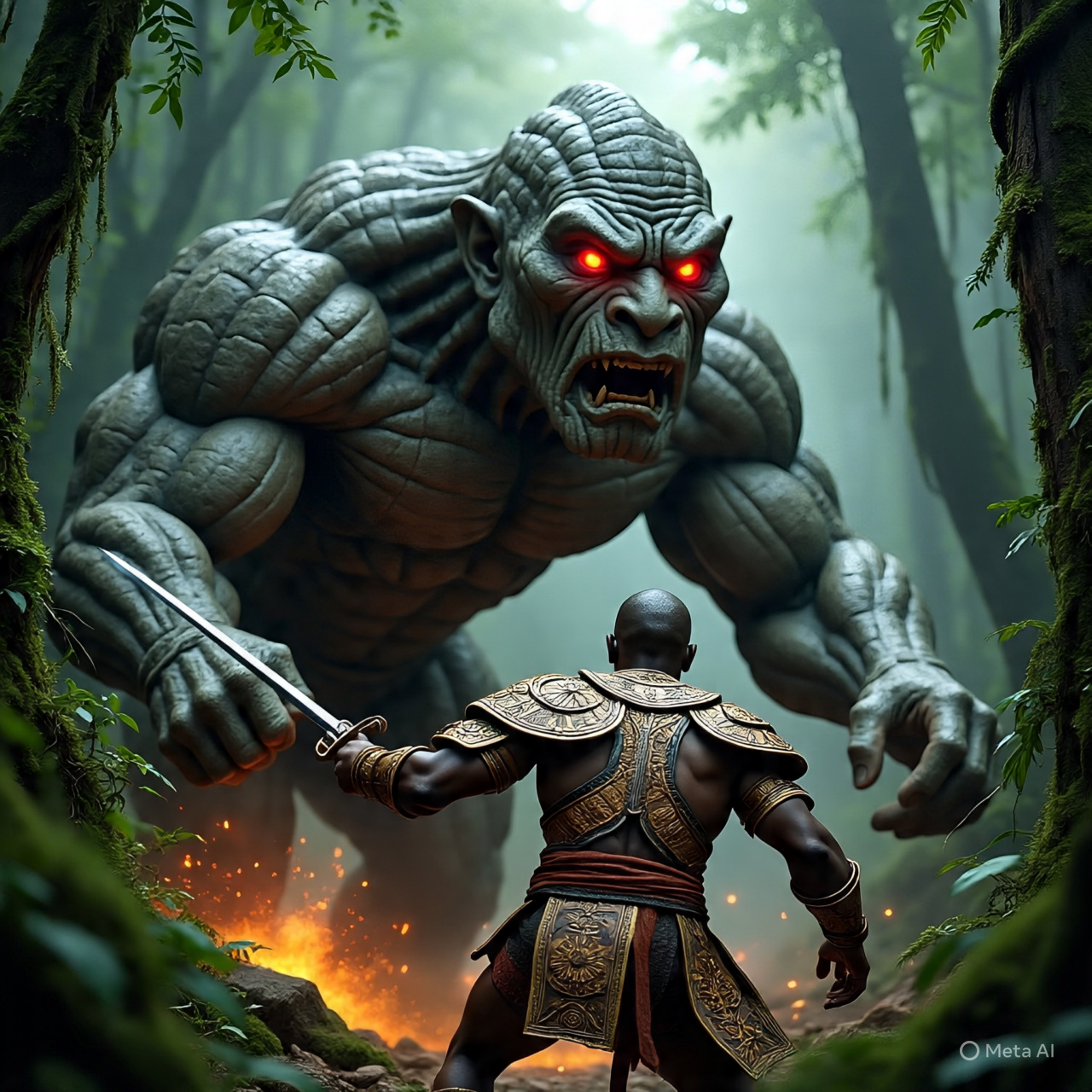
When Shango’s hailstones pummelled the earth, it was a final gambit, a bid to overwhelm the thunder deity’s many adversaries with the force of sheer numbers. As they struck with a noise of great shattering, they split open to reveal red-eyed, vulpine creatures, more beast than otherwise, that surged forward to claw and slash, to grind and gnaw.
In a funk he could not hope to comprehend, Baragbon seemed to watch himself flail with blade and axe against this new and terrible onslaught. Before long, another half of their number was decimated, but in the end the alliance of Eledumare the mighty prevailed. Even as sparks and shards of the war machines of Ogun Ore-smith – who fought at Shango’s side – still clamoured in the sky, it was clear the tide had turned in their favour.
In this aftermath, Baragbon felt inside himself once more, but whatever feeling of relief he attained was tinged with loss and mild regret. The errant demi-gods fled into ether, leaving their malevolent creations behind: lumbering golems and winged halflings that tottered and blinked in post-war delirium. It was inside this settling dust that he observed clearly for the first time the raw, elemental power of the celestials as they laid aside arms and went to work on the hailstones themselves.
He watched as the gods kneaded them into more benign aspects, shrinking their awesome size until they were miniaturized (a particular one – Eshu, he dared suspect, from the jagged formations in its grinning maw which served as teeth – giggling as it pummelled them into diminutive shape).
And then they turned their attention to he and his men.
Eventually marching out from the forest, Baragbon and the other warriors found the land altered with signs of earthly upheavals that had been thankfully truncated – but so also were they, indelibly, and to an extent that within days of their return home it sent them retreating back into the woods from which they’d earlier emerged.
They had to. Other townsfolk had begun to labour under the effect of unseen powers radiating from their bodies – inexplicable energies which emanated from their very skins and eyes to permeate the minds of others unlike them, and drawing out the rawest, most primal emotions within. Proximity beyond an arm’s length was akin to a fiery inquisition into the intents and motives of others, with every deceit, every falsehood made instantly accessible to them that had fought alongside the gods.
Initially marvelling, the ordinary populace quickly grew uneasy and fearful in the face of such powers before ultimately turning resentful – who could long withstand such probing agonies? They complained to the Oba, who at first tried to placate, citing the great thing the warriors had done to preserve the kingdom. However, it was not enough. After barely several moons Baragbon and his men were driven from the town they’d selflessly sacrificed part of their humanity for.
What is known afterward came from the accounts of wives and close relatives who dared brave the intense psychic inquisitions to visit the men now living deep inside the forest. They came out describing a large swath of blasted land on the edge of the field of celestial battle that had been transformed to reflect the heavens from whence the gods had descended. Others went in, willingly suffering the same stresses in order to seek help with various problems and ailments, and most returned speaking of cures to sicknesses and infirmities achieved by the laying of hands and application of herbal ointments by Baragbon and his band of ex-warriors.
There was talk of strange fires where the men were found, ones that burned ceaselessly within the walls of a ‘city of light’. Gourds were found holding pools of pale liquid in whose depth images of people from faraway distances were revealed as if within touching distance. Visitors ate quick satiating grains and drank of beverages that were cooler, more energising than the water from Oya’s purest streams.
As people also ventured into the forest beyond to pay homage at a field where lay the petrified war dogs – mere stone sentinels, now – and other totems, they found Baragbon and the others not resentful of their past rejection. Indeed, the old warriors often acted as go-betweens, ready to explain as best they could the wonders witnessed as well as interpret the intent of the gods in whose sacred places they now dwelled.
In time, he and his men were regarded as the first Ifa – priests – and among them he was the first Aworo – high priest – to tend to the arcane power residing in that place.
Comments ()
Loading comments...
No comments yet
Be the first to share your thoughts!
Sign in to reply
Sign InYou'll be asked to sign in before posting — your comment is saved.