
There is a particular kind of silence that sits in your chest the moment the bus turns into camp.
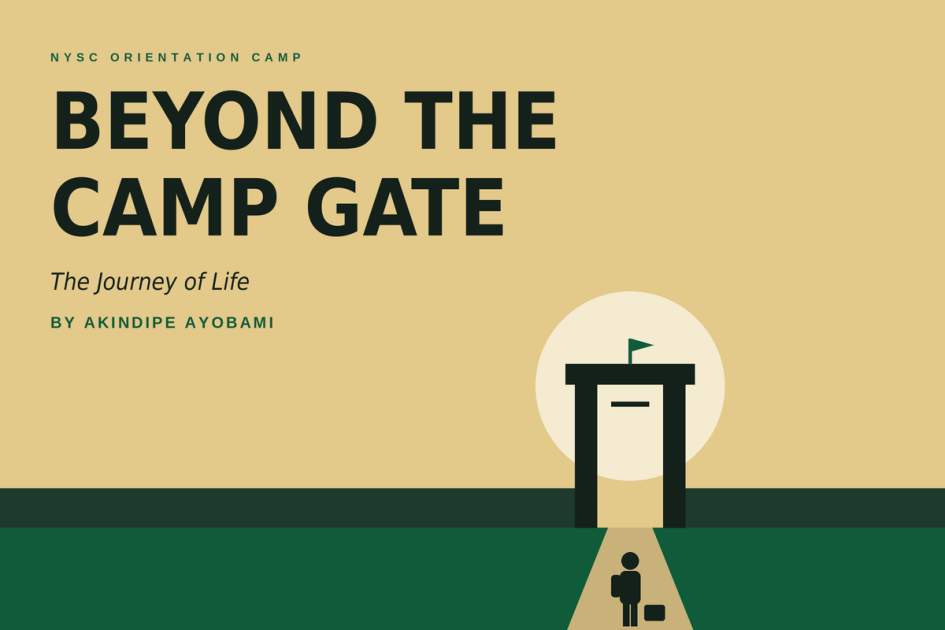
You have your box. Your bag. Maybe two. Your mother's voice still echoing in your ear from the motor park: "take care of yourself o, call me when you reach." Your father's handshake that lasted a second too long, like he wanted to say something he didn't have the words for. And now here you are, standing at the gate, holding everything you own in this world in two hands, and holding everything you don't know about your future in your chest.
This is where it begins. Not just camp, life.
You don't know it yet, but the gate you are about to walk through is not just made of iron and paint. It is the gate every one of us walks through, again and again, every time an old chapter ends and a new one refuses to introduce itself before it starts.
The Gate
Nobody walks through a new gate with full understanding of what's on the other side. You didn't fully understand the last one either, the one into university, into your first job, into your first heartbreak, into adulthood itself. You just walked. That is the secret nobody tells you: courage is not the absence of confusion. Courage is walking anyway.
At the camp gate, you meet strangers instantly becoming neighbours. A boy from Sokoto stands beside a girl from Aba. A Yoruba graduate from Ekiti drops his bag next to a Tiv boy from Benue. Different tongues, different gods, different family stories, and yet, in a few hours, they will all be assigned to the same hostel, eat from the same plate of camp rice, and answer to the same whistle. Life does this too. It does not care where you are coming from. It only cares that you keep walking forward.
The Waiting
Before anything else, there is registration. There is documentation. There are queues that stretch under the sun until your legs forget they are legs and become simply things that stand.
This is life's oldest lesson, and camp teaches it fast: progress often demands patience it does not explain.
You will stand in queues in life that have nothing to do with camp, queues for visas, for job interviews, for answers that take years to arrive, for love that takes its time to recognize you. Some people ahead of you will move quickly. Some behind you will somehow get served first. You will want to ask why. Camp does not answer. Neither does life. You simply learn to stand, and to trust that your turn is still coming, even when it is invisible.
The Uniform
Then they hand you the khaki.
We wear white white both the rich, middle and poor.
And something strange happens. The girl who came in designer heels and the boy who came in worn slippers now wear the exact same shirt, the exact same cap, the exact same size of belonging. Nobody can tell, by looking, who was the company director's child and who trekked to catch the first bus. For three weeks, everybody is simply a corps member.
This is one of life's most humbling truths dressed in green and white: titles fade, currencies change, but under it all, we are the same fragile, striving human beings. The camp uniform does not just clothe the body, it strips the ego. Life will do this to you too, sooner or later. It has a way of reminding the proud and the humble alike that we all bleed the same, fear the same, hope the same.
The Parade Ground
4:30 a.m. The whistle blows before the sun even considers rising. Your body screams for five more minutes, but your legs are already moving, because somewhere you learned that discipline does not wait for motivation to show up.
The parade ground is punishing. The drills repeat. Left, right, left, right, the same motion, again and again, until your body stops asking why and simply obeys. This is what growth actually looks like, not the dramatic, cinematic version we imagine, but this: waking up tired and showing up anyway. Doing the same unglamorous thing daily until it becomes who you are.
Nobody claps for you on the parade ground at 5 a.m. Nobody is watching. And that is exactly the point. Life's deepest growth happens in the unseen hours, when no audience is present to reward your discipline, only your future self, quietly taking notes.
The Instructions
The soldiers shout. They correct. They punish small infractions with frog jumps and long laps that make your thighs burn for days. In the moment, it feels excessive, even unfair.
But somewhere between week one and week two, you begin to understand: discipline is not cruelty, it is a rough kind of love that refuses to let you stay soft in a world that will not be gentle with you. Life corrects us the same way, through loss, through failure, through the sting of consequences we didn't see coming. We rarely enjoy the correction. But we carry its shape in us long after the pain fades, and it becomes the very structure that holds us upright.
The Friendships
And then, almost without warning, there are the people.
The roommate who shares her last chin chin, snacks, chips, and especially garri and milk with you at midnight. The platoon mate who becomes your training partner and somehow becomes family within days. The stranger who sits beside you on the mattress, and by week three, knows your fears better than people who have known you for years.
Nobody plans these friendships. They simply happen, in the queue, in the hostel, on the parade ground, SAED lectures, when visitors came in, even at social nights, over shared frustration and shared laughter. This is life's quiet mercy: the people who matter most rarely arrive with warning. They walk in through an ordinary door, a classroom, a bus stop, a camp gate, and quietly become extraordinary.
Some of these camp friendships fade after three weeks. Some last a lifetime. Some become love. Some become business partners years later. Some you will never see again, yet you will remember their face forever. Life does not promise you will keep everyone camp gives you. It only promises that everyone camp gives you will change you, even briefly.
The Obstacles
There is a day set aside for it, Man O' War. The rope crawl. The wall you must climb with mud on your hands and fear in your throat. The tyres you must jump through even when your legs are already trembling from exhaustion.
Some scale the wall on the first try. Some fall, and try again. Some need a hand from a stranger who has already made it over. Nobody skips the obstacle course and still calls it camp.
Nobody skips their obstacles and still calls it a full life either. The struggle is not a malfunction in the journey, it is the journey. We do not get to opt out of difficulty. We only get to choose whether we face it with our chin up or dragging behind us.
The Platoons
You are placed in a platoon, 1, 2, 3, 4, 5, 6, 7, 8, 9, or 10. I fell into the big 7, the master of all platoons. You did not choose it. It was assigned to you, seemingly at random, the way life assigns you a family, a body, a birth year, a nationality, none of which you selected.
Different platoons march differently. Some are louder. Some are more disciplined. Some struggle more with the drills. But by passing out day, they all arrive at the same parade ground, wearing the same white and green, having survived the same three weeks.
This is life in miniature: we do not all travel the same road, but many of us are walking toward the same things, purpose, belonging, growth, meaning. Stop comparing your platoon's pace to another's. You are not behind. You are simply on a different route to the same field.
The Extension
And then, just when you thought you knew the date of your freedom, an announcement comes: camp has been extended. Just one more day added to the usual twenty one, making it twenty two in camp, breaking a record in NYSC history (the kind of record nobody actually wanted to be part of, but somehow we still managed to laugh about later). Small as it sounds, that one extra day rearranged everything you had already mentally packed your bags for. A groan moves through the hostel like a wave. Faces that were smiling at breakfast go quiet by lunch. Somebody starts crying near the mattress. Somebody else just stares at the wall, silent, doing the math on money running low and a family waiting at home.
Nobody warned you plans could shift this suddenly. You had already counted the days, already imagined the moment you'd walk back through that gate a free person, and now the goalpost has moved without asking your permission.
This, too, is life, wearing its cruellest and most honest face: the finish line you were promised is not always the finish line you get. Sometimes the wait stretches longer than you budgeted for, the job that was supposed to come in three months takes a year. The relationship you thought was closing chapter becomes an unexpected extension. The healing you hoped would be quick refuses to hurry. And in that stretched, uncertain in between, worry creeps in exactly the way it crept into that hostel, quietly, then all at once.
But here is what the extension also teaches, if you let it: you survive it. The days you feared you couldn't bear, you bear. The date changes, but you do not break. You wake up on day twenty two the same way you woke up on day one, tired, uncertain, but still standing. Life will hand you extensions you did not ask for. The measure of you is not whether you avoid them. It is whether you keep showing up while the goalpost keeps moving.
Passing Out Day
And then, almost too suddenly, it is over.
The same gate you walked through with confusion, you now walk through with a certificate in your hand and a story in your chest that nobody who wasn't there will ever fully understand. Somebody found love in those three weeks. Somebody found a business partner. Somebody found clarity about who they want to become. And somebody, quietly, painfully, leaves with the exact same questions they arrived with. Camp does not promise answers for everyone. It only promises the experience of searching.
This, too, is life's rhythm: every phase ends, whether or not you feel ready. School ends. Relationships end. Jobs end. Seasons end. Nobody asks if you have finished processing the last chapter before ushering in the next. You pick up your bag, heavier now with memory, lighter now with lessons, and you walk toward another gate you cannot yet see.
The Truth Beneath It All
NYSC camp is not just a place where graduates wake early, march under a punishing sun, and wear a uniform for three weeks. It is a rehearsal, a small, compressed version of the larger performance called life. A place where strangers become family. Where comfort is never promised. Where discipline is forced before it is chosen. Where you learn, painfully, that growth rarely feels like growth while it is happening.
Life, like camp, does not promise comfort.
Sometimes you will stand in long queues without knowing when your turn will come. Sometimes you will wake up tired, uncertain, unmotivated, and still have to show up, because the whistle does not wait for your mood to improve. Sometimes the person standing next to you in an ordinary queue will become one of the most important people you ever meet. And eventually, when one phase closes, you will have to zip up your bag again, sling it over your shoulder, and walk, tired, uncertain, but still walking, through another gate into the unknown.
The question was never whether the journey would be difficult.
The question has always been: will you let the difficulty make you bitter, or will you let it make you strong?
Camp ends. But the gate, that particular kind of gate, the one that demands you leave something behind to receive something ahead, that gate will keep appearing, for as long as you are alive to walk through it.
So walk.
Even confused. Even tired. Even unsure what platoon life has placed you in.
Walk, because on the other side of every gate you have ever feared, there was always a version of you strong enough to make it through.
There will always be another gate.
Keep your bag ready.
Comments ()
Loading comments...
No comments yet
Be the first to share your thoughts!
Sign in to reply
Sign InYou'll be asked to sign in before posting — your comment is saved.